

Did Women Used To Leave Makeup On All The Time
This section includes products such equally rouges and lipsticks. The text below provides some historical context and shows how we can use these products to explore aspects of American history, for case, the links between changes in American feminine identity and the American beauty manufacture. To skip the text and get straight to the objects, CLICK HERE
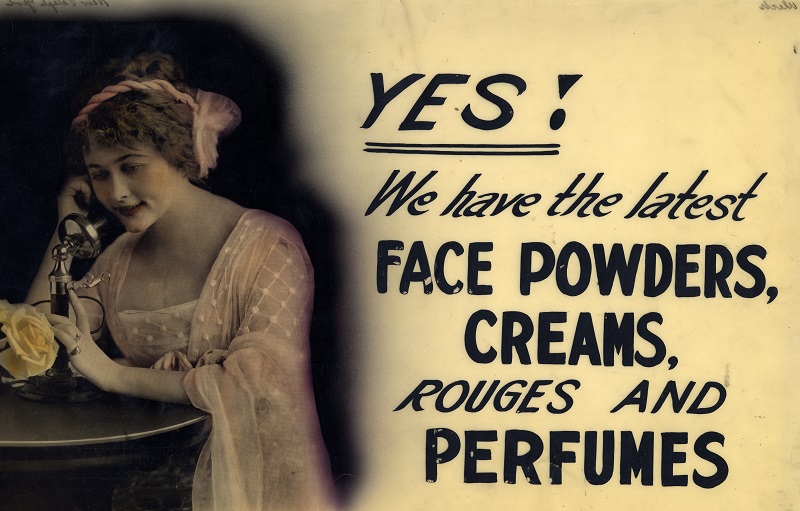 |
| A shop window ad sign depicting a pale-complected, cerise-lipped dazzler idealized at the start of the 20th century. Warshaw Collection of Business Americana, Archives Middle, National Museum of American History, Smithsonian Institution |
In eighteenth century America, both men and women of the upper classes wore make-up. But, shortly after the American Revolution the utilise of visible "pigment" cosmetics (colored cosmetic for lips, skin, eyes, and nails) by either gender gradually became socially unacceptable. For most of the nineteenth century few paint cosmetics were manufactured in America. Instead, women relied on recipes that circulated amongst friends, family unit, and women'due south magazines; using these recipes, they discreetly prepared lotions, powders, and skin washes to lighten their complexions and diminish the appearance of blemishes or freckles. Druggists sold ingredients for these recipes, as well equally the occasional set-made training. Painting i'southward face was considered vulgar and was associated with prostitution, so whatever product used needed to appear "natural." Some women secretly stained their lips and cheeks with pigments from petals or berries, or used ashes to darken eyebrows and eyelashes. Woman worked to attain the era'due south ideal feminine identity; a "natural" and demure woman with a stake-complexion, rosy lips and cheeks, and bright eyes.
In the 1880s, entrepreneurs began to produce their own lines of cosmetic products that promised to provide a "natural" look for their customers. Some of these new companies were small, adult female-owned businesses that typically used an agent organisation for distribution as pioneered by the California Perfume Company, later rebranded as Avon. This business organization model allowed many women to make coin independently. Also, more women were earning wages and buying cosmetics, thereby enlarging the market further. Women could make a living in the burgeoning cosmetics trade as business owners, agents, or manufacturing plant workers. Near of these entrepreneurs came from fairly humble origins, and some managed to transform their local operations into successful businesses with a broad distribution of their products. Florence Nightingale Graham, for instance, was the daughter of tenant farmers, and worked many low-paying jobs before opening a beauty shop for aristocracy clients and reinventing herself as Elizabeth Arden. African American women also found success through this model, simply faced extra obstacles. Many white shop owners refused to consider stocking African American beauty products until successful businesses like that of Madam C. J. Walker created plenty of a demand through other distribution channels.
By the 1920s, information technology was fashionable for women, especially in cities, to clothing more than conspicuous brand-up. This shift reflected the growing influence of Hollywood and its glamourous new film stars, besides every bit the style of theater stars and flappers. "Painted" women could now also place as respectable women, even as they wore dramatic mascara, eyeliner, dusky eyeshadow, and lipstick like the stars of the screen. The growing indigenous variety of the The states as well influenced how cosmetics companies marketed their products. "Exotic" or "attracting" ethnic stereotypes became inspirations for brand-up fashions that ostensibly reflected the American melting pot. White women could experiment with a trendy, exotic identity – and then wash it off. African American identity, however, was explicitly excluded from this ethnic mingling. In the late 1920s and 1930s, information technology became stylish for white women to sport the advent of a "healthy" tan. Previously, a tan had been equated with working-class women who performed outdoor labor; at present a tan identified a woman as modernistic and healthy, participating in outdoor recreations and leisure. Make-upwards colors were marketed in various "suntanned" shades, giving women the selection to remove the "tan" whenever they wished to reclaim a off-white complexion.
At this fourth dimension, the cosmetics business organization experienced a major shift. Minor cosmetics companies, many of which were owned by women, were replaced past larger corporations. Business concern models had changed: in society to remain competitive and achieve wide distribution, a business had to engage in wholesale bargaining with male person-owned concatenation drug and department stores. Because women were usually excluded from these distribution channels, nearly female person-owned businesses could not compete. By 1930, a small scattering of companies controlled 40% of the cosmetics industry. These companies now released thousands of factory-produced, similar products under various brand names.
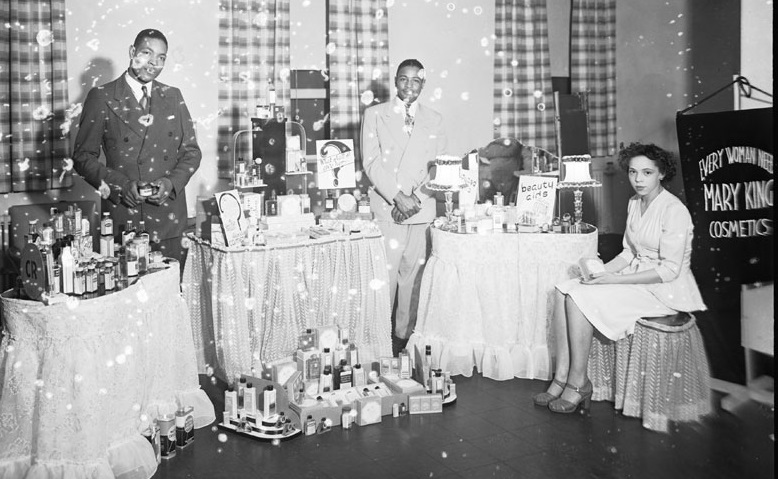 |
| 1930: The J.R. Watkins Company endemic the Mary Male monarch Cosmetics line. Hither, agents sell Watkins products and Mary King cosmetics. Scurlock Studio Records, Archives Heart, National Museum of American History, Smithsonian Institution |
Spending on cosmetics increased dramatically when millions of women entered the workforce during the 2nd Earth War, gaining greater independence and purchasing power. Younger women embraced an overtly flirtatious persona, signaled through the conspicuous use of assuming rouge, pulverisation, lipstick, and smash smoothen. Many working women wore shorter, more than "manly" hair styles, and brand-upwardly was used to reassert femininity. When nylon stockings became unavailable because of state of war-time commodity shortages, women turned to leg make-upward—pigment-on hosiery maintained the illusion of nylon-clad legs. Cosmetics advertisements and armed forces recruiting campaigns during the war emphasized women'due south dual responsibilities: support the state of war effort and maintain one'south feminine identity through the use of brand-up. Government-produced posters encouraging women to join the war endeavor depicted female person nurses and factory workers in vivid ruby lipstick and dark mascara. Makeup, specially lipstick, had go such an essential component of American femininity, that the federal government quickly rescinded its wartime materials-rationing restrictions on cosmetics manufacturers in club to encourage use of brand-upwardly. As Kathy Peiss writes in "Hope in a Jar," the employ of make-upwardly had become "an exclamation of American national identity."
After the state of war, 80-90% of American women wore lipstick, and companies like Avon and Revlon capitalized on this now-ingrained style. By the 1950s and 1960s, teenage girls were unremarkably wearing make-up and cosmetic companies devised separate marketing campaigns to target the younger age groups.
In the late 1960s, using makeup became politicized. Counter-cultural movements celebrated ideals of natural beauty, including a rejection of make-up birthday. Cosmetics companies returned to advertisements that claimed that their products provided a "natural" await. These ideals still relied on racial whiteness as the basis of feminine dazzler, only under continued pressure from women of colour, major cosmetics firms began to cater to the African American market, not only by producing products geared toward black women (often under dissever brands), only besides by hiring black women as sales agents. Even so, the so-called "ethnic" segment of the corrective market place remained pocket-sized, making up just two.3% of full sales in 1977.
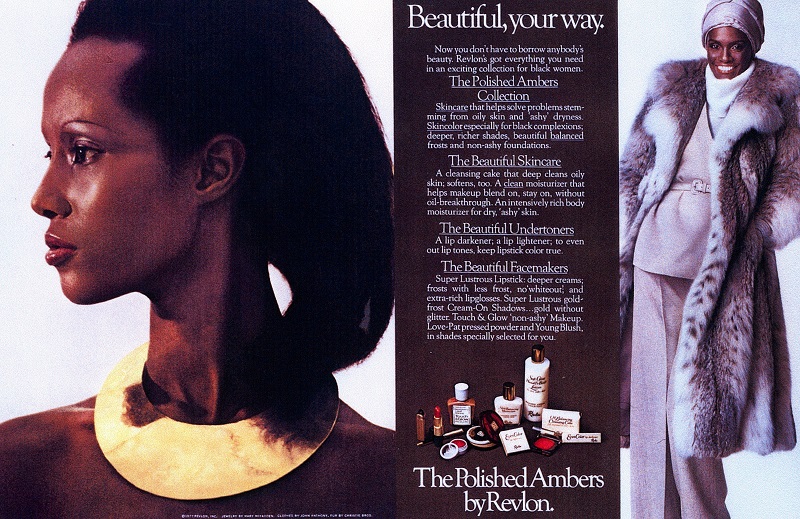 |
| 1977 Revlon advertising campaign for the "Polished Ambers collection...an exciting collection for black women." Revlon Advert Collection, Archives Center, National Museum of American History, Smithsonian Institution |
Bibliography ~ come across the Bibliography Section for a full list of the references used in the making if this Object Group. Notwithstanding, the Make-up section relied on the following references:
Gill, Tiffany M. Dazzler Shop Politics: African American Women's Activism in the Dazzler Manufacture. Urbana; Chicago: University of Illinois Press, 2010.
Jones, Geoffrey. Beauty Imagined: A History of the Global Beauty Industry. Oxford; New York: Oxford University Press, 2010.
Jones, Geoffrey. "Blonde and Blue-eyed? Globalizing Beauty, c.1945–c.19801." The Economic History Review 61, no. 1 (February ane, 2008): 125–54. doi:10.1111/j.1468-0289.2007.00388.ten.
Morris, Edwin T. Fragrance: The Story of Perfume from Cleopatra to Chanel. New York: Scribner, 1984.
Peiss, Kathy Lee. Hope in a Jar: The Making of America'due south Beauty Culture. New York: Metropolitan Books, 1998.
Scranton, Philip. Beauty and Business organization: Commerce, Gender, and Civilization in Modern America. New York: Routledge, 2001.
Source: https://www.si.edu/spotlight/health-hygiene-and-beauty/make-up
Posted by: putnammosion.blogspot.com
0 Response to "Did Women Used To Leave Makeup On All The Time"
Post a Comment