

How Has The Religious Makeup Outcome Changes Over The Years In New York

 The Christian share of the U.Due south. population is declining, while the number of U.S. adults who do not identify with whatever organized religion is growing, co-ordinate to an extensive new survey by the Pew Research Center. Moreover, these changes are taking identify across the religious landscape, affecting all regions of the land and many demographic groups. While the drop in Christian amalgamation is peculiarly pronounced among young adults, it is occurring among Americans of all ages. The same trends are seen amidst whites, blacks and Latinos; amidst both college graduates and adults with but a high schoolhouse education; and among women besides as men. (Explore the information with our interactive database tool.)
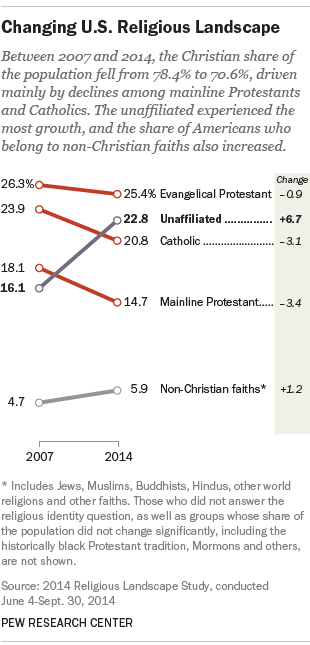
To be sure, the Usa remains home to more Christians than any other country in the world, and a big majority of Americans – roughly seven-in-ten – continue to identify with some branch of the Christian faith.1 But the major new survey of more than 35,000 Americans past the Pew Research Center finds that the percentage of adults (ages eighteen and older) who draw themselves as Christians has dropped by nearly eight percentage points in just seven years, from 78.iv% in an equally massive Pew Research survey in 2007 to 70.6% in 2014. Over the same menstruum, the percent of Americans who are religiously unaffiliated – describing themselves equally atheist, agnostic or "goose egg in item" – has jumped more than six points, from sixteen.one% to 22.8%. And the share of Americans who identify with not-Christian faiths also has inched up, rising i.2 percentage points, from 4.vii% in 2007 to five.9% in 2014. Growth has been especially bang-up amid Muslims and Hindus, admitting from a very low base.
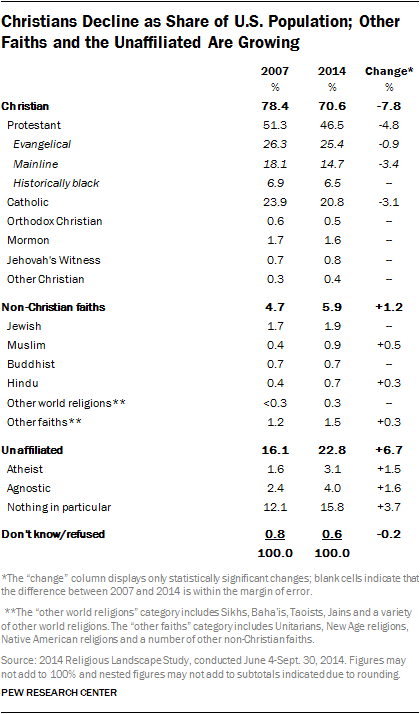 The drop in the Christian share of the population has been driven mainly past declines among mainline Protestants and Catholics. Each of those large religious traditions has shrunk by approximately 3 percentage points since 2007. The evangelical Protestant share of the U.S. population also has dipped, but at a slower rate, falling by virtually one percent point since 2007.2
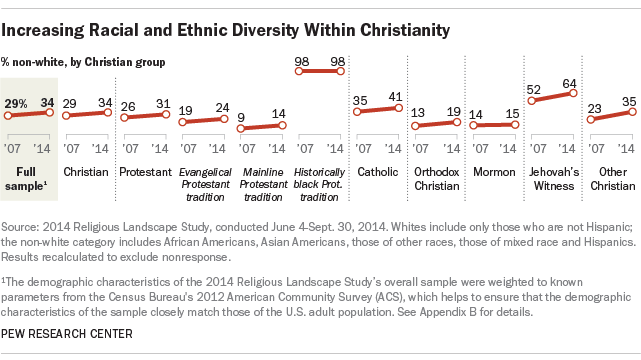
Fifty-fifty as their numbers decline, American Christians – similar the U.S. population every bit a whole – are becoming more racially and ethnically diverse. Not-Hispanic whites at present business relationship for smaller shares of evangelical Protestants, mainline Protestants and Catholics than they did vii years before, while Hispanics take grown as a share of all three religious groups. Racial and ethnic minorities now brand upwardly 41% of Catholics (up from 35% in 2007), 24% of evangelical Protestants (up from 19%) and 14% of mainline Protestants (upward from ix%).
Religious intermarriage also appears to be on the rising: Among Americans who have gotten married since 2010, nigh iv-in-ten (39%) study that they are in religiously mixed marriages, compared with 19% amongst those who got married earlier 1960.iii The rise in intermarriage appears to be linked with the growth of the religiously unaffiliated population. Virtually one-in-v people surveyed who got married since 2010 are either religiously unaffiliated respondents who married a Christian spouse or Christians who married an unaffiliated spouse. Past contrast, merely five% of people who got married before 1960 fit this contour.
Explore information on religious groups in the U.S. by affiliation, geographic and demographic data.
While many U.Southward. religious groups are aging, the unaffiliated are insufficiently young – and getting younger, on average, over time. As a ascension cohort of highly unaffiliated Millennials reaches adulthood, the median age of unaffiliated adults has dropped to 36, down from 38 in 2007 and far lower than the general (adult) population's median age of 46.4 By dissimilarity, the median historic period of mainline Protestant adults in the new survey is 52 (up from 50 in 2007), and the median historic period of Catholic adults is 49 (up from 45 vii years earlier).
These are among the key findings of the Pew Research Middle's 2nd U.S. Religious Landscape Study, a follow-upwards to its kickoff comprehensive study of religion in America, conducted in 2007.
Because the U.S. census does not ask Americans almost their organized religion, in that location are no official government statistics on the religious composition of the U.South. public.5 Some Christian denominations and other religious bodies keep their own rolls, simply they use widely differing criteria for membership and sometimes do not remove members who take fallen away.6 Surveys of the general public frequently include a few questions almost religious amalgamation, but they typically do not interview plenty people, or ask sufficiently detailed questions, to exist able to depict the country'southward full religious landscape.
The Religious Landscape Studies were designed to fill the gap. Comparing ii nigh identical surveys, conducted seven years apart, tin bring important trends into sharp relief. In add-on, the very large samples in both 2007 and 2014 included hundreds of interviews with people from small religious groups that account for just 1% or 2% of the U.S. population, such as Mormons, Episcopalians and Seventh-24-hour interval Adventists. This makes information technology possible to paint demographic and religious profiles of numerous denominations that cannot be described by smaller surveys. The most recent Religious Landscape Written report as well was designed to obtain a minimum of 300 interviews with respondents in each state and the District of Columbia as well as to represent the state's largest metropolitan areas, enabling an assessment of the religious limerick not just of the nation every bit a whole, but besides of individual states and localities. (See Appendix D.)
The latest survey was conducted in English and Castilian among a nationally representative sample of 35,071 adults interviewed by phone, on both cellphones and landlines, from June iv-Sept. 30, 2014. Findings based on the full sample have a margin of sampling fault of plus or minus 0.6 percentage points. The survey is estimated to cover 97% of the not-institutionalized U.S. adult population; 3% of U.Southward. adults are not reachable by phone or do not speak English or Spanish well plenty to participate in the survey. (Come across Appendix A for more information on how the survey was conducted, margins of mistake for subgroups analyzed in this written report and additional details.)
Even a very modest margin of mistake, when applied to the hundreds of millions of people living in the The states, can yield a wide range of estimates for the size of particular faiths. Even so, the results of the second Religious Mural Study indicate that Christians probably have lost ground, not only in their relative share of the U.S. population, only likewise in accented numbers.
In this study, respondents' religious affiliation (likewise sometimes referred to as "religious identity") is based on cocky-reports. Catholics, for case, are defined as all respondents who say they are Catholic, regardless of their specific behavior and whether or not they nourish Mass regularly.
The terms "unaffiliated" and "religious 'nones'" are used interchangeably throughout this report. This group includes cocky-identified atheists and agnostics as well as those who depict their religion as "zip in detail."
The unaffiliated are generally less religiously observant than people who identify with a religion. Just not all religious "nones" are nonbelievers. In fact, many people who are unaffiliated with a religion believe in God, pray at to the lowest degree occasionally and think of themselves as spiritual people. Forthcoming reports will describe the Religious Landscape Study's findings about the religious beliefs and practices of "nones" and other groups.
For more details on the exact questions used to measure religious identity, run into the survey topline. For more on how Protestant respondents were grouped into particular religious traditions, run into Appendix B.
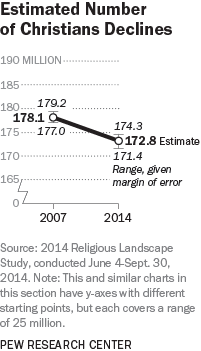 In 2007, there were 227 meg adults in the United States, and a little more than 78% of them – or roughly 178 million – identified as Christians. Between 2007 and 2014, the overall size of the U.S. adult population grew by most xviii meg people, to almost 245 million.vii But the share of adults who identify as Christians fell to just under 71%, or approximately 173 million Americans, a net decline of about 5 meg.
This decline is larger than the combined margins of sampling error in the twin surveys conducted seven years apart. Using the margins of error to calculate a likely range of estimates, it appears that the number of Christian adults in the U.S. has shrunk past somewhere betwixt 2.8 million and 7.viii million.8
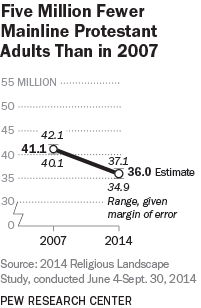 Of the major subgroups within American Christianity, mainline Protestantism – a tradition that includes the United Methodist Church building, the American Baptist Churches USA, the Evangelical Lutheran Church building in America, the Presbyterian Church (United states of americaA.) and the Episcopal Church building, among others – appears to have experienced the greatest drop in absolute numbers. In 2007, there were an estimated 41 meg mainline Protestant adults in the United States. As of 2014, there are roughly 36 1000000, a turn down of 5 million – although, taking into account the surveys' combined margins of error, the number of mainline Protestants may have fallen by as few as 3 1000000 or as many as 7.3 one thousand thousand between 2007 and 2014.9
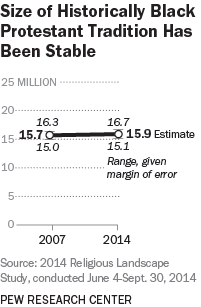 By contrast, the size of the historically blackness Protestant tradition – which includes the National Baptist Convention, the Church building of God in Christ, the African Methodist Episcopal Church, the Progressive Baptist Convention and others – has remained relatively stable in recent years, at nearly sixteen million adults. And evangelical Protestants, while declining slightly every bit a percent of the U.South. public, probably have grown in absolute numbers as the overall U.S. population has connected to expand.
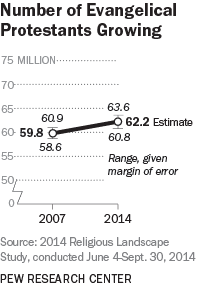 The new survey indicates that churches in the evangelical Protestant tradition – including the Southern Baptist Convention, the Assemblies of God, Churches of Christ, the Lutheran Church building-Missouri Synod, the Presbyterian Church in America, other evangelical denominations and many nondenominational congregations – at present have a total of about 62 1000000 developed adherents. That is an increase of roughly two million since 2007, though in one case the margins of fault are taken into account, information technology is possible that the number of evangelicals may have risen by as many as 5 million or remained substantially unchanged.ten
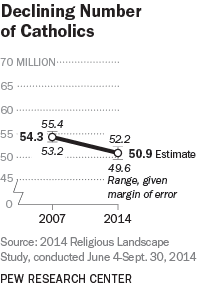 Like mainline Protestants, Catholics appear to be declining both as a percentage of the population and in accented numbers. The new survey indicates in that location are about 51 meg Catholic adults in the U.S. today, roughly 3 million fewer than in 2007. Merely taking margins of error into account, the decline in the number of Catholic adults could exist equally pocket-size as 1 million.11 And, unlike Protestants, who take been decreasing equally a share of the U.S. public for several decades, the Catholic share of the population has been relatively stable over the long term, according to a variety of other surveys (see Appendix C).
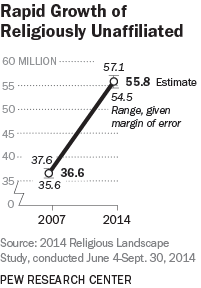 Meanwhile, the number of religiously unaffiliated adults has increased by roughly xix million since 2007. In that location are now approximately 56 1000000 religiously unaffiliated adults in the U.S., and this grouping – sometimes called religious "nones" – is more than numerous than either Catholics or mainline Protestants, according to the new survey. Indeed, the unaffiliated are at present second in size simply to evangelical Protestants amongst major religious groups in the U.S.
Factors Behind the Changes in Americans' Religious Identification
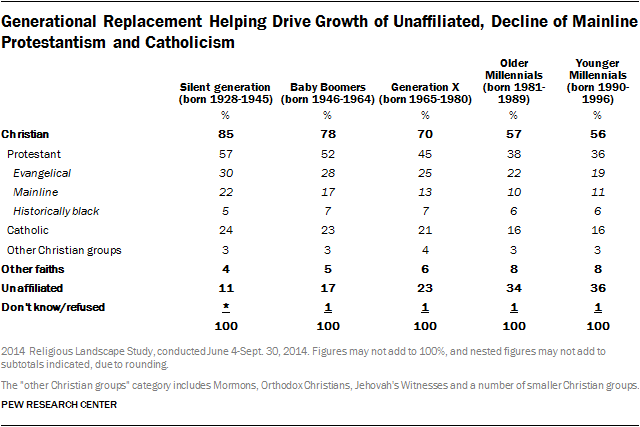
One of the most important factors in the declining share of Christians and the growth of the "nones" is generational replacement. Equally the Millennial generation enters machismo, its members brandish much lower levels of religious affiliation, including less connection with Christian churches, than older generations. Fully 36% of young Millennials (those between the ages of 18 and 24) are religiously unaffiliated, every bit are 34% of older Millennials (ages 25-33). And fewer than six-in-ten Millennials identify with whatever branch of Christianity, compared with seven-in-x or more than amongst older generations, including Baby Boomers and Gen-Xers. Merely sixteen% of Millennials are Catholic, and only xi% identify with mainline Protestantism. Roughly one-in-five are evangelical Protestants.
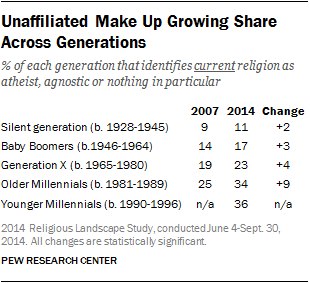 However, generational replacement is by no means the only reason that religious "nones" are growing and Christians are declining. In addition, people in older generations are increasingly disavowing association with organized religion. Nearly a third of older Millennials (adults currently in their tardily 20s and early on 30s) now say they have no religion, upwards nine percentage points amidst this cohort since 2007, when the same grouping was betwixt ages 18 and 26. Virtually a quarter of Generation Xers now say they accept no particular religion or describe themselves every bit atheists or agnostics, up four points in seven years. Baby Boomers also have go slightly simply noticeably more probable to identify as religious "nones" in recent years.
As the shifting religious profiles of these generational cohorts suggest, switching faith is a common occurrence in the United States. If all Protestants were treated as a single religious grouping, then fully 34% of American adults currently have a religious identity different from the one in which they were raised. This is upward six points since 2007, when 28% of adults identified with a religion different from their childhood faith. If switching amidst the three Protestant traditions (e.g., from mainline Protestantism to the evangelical tradition, or from evangelicalism to a historically blackness Protestant denomination) is added to the total, then the share of Americans who currently have a different faith than they did in babyhood rises to 42%.
By a wide margin, religious "nones" take experienced larger gains through religious switching than any other grouping. About i-in-5 U.S. adults (18%) were raised in a religious faith and now place with no religion. Some switching also has occurred in the other direction: 9% of American adults say they were raised with no religious affiliation, and almost one-half of them (four.iii% of all U.S. adults) at present place with some organized religion. But for every person who has joined a faith after having been raised unaffiliated, there are more four people who have become religious "nones" after having been raised in some religion. This i:4 ratio is an important gene in the growth of the unaffiliated population.
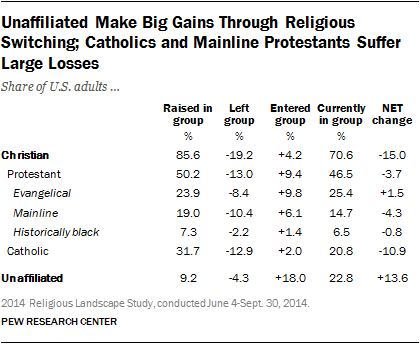 By contrast, Christianity – and especially Catholicism – has been losing more adherents through religious switching than it has been gaining. More than 85% of American adults were raised Christian, simply virtually a quarter of those who were raised Christian no longer identify with Christianity. Former Christians represent xix.2% of U.S. adults overall.
Both the mainline and historically black Protestant traditions have lost more than members than they take gained through religious switching, only within Christianity the greatest cyberspace losses, by far, have been experienced by Catholics. Nearly one-third of American adults (31.seven%) say they were raised Catholic. Among that grouping, fully 41% no longer identify with Catholicism. This means that 12.9% of American adults are former Catholics, while just 2% of U.Southward. adults have converted to Catholicism from another religious tradition. No other religious group in the survey has such a lopsided ratio of losses to gains.
The evangelical Protestant tradition is the just major Christian group in the survey that has gained more than members than information technology has lost through religious switching. Roughly x% of U.S. adults now identify with evangelical Protestantism afterward having been raised in some other tradition, which more than offsets the roughly 8% of adults who were raised as evangelicals simply accept left for another religious tradition or who no longer identify with any organized organized religion.
Other highlights in this report include:
- The Christian share of the population is declining and the religiously unaffiliated share is growing in all 4 major geographic regions of the state. Religious "nones" now constitute 19% of the adult population in the South (upward from 13% in 2007), 22% of the population in the Midwest (upwardly from 16%), 25% of the population in the Northeast (up from sixteen%) and 28% of the population in the West (up from 21%). In the Due west, the religiously unaffiliated are more numerous than Catholics (23%), evangelicals (22%) and every other religious group.
- Whites continue to be more likely than both blacks and Hispanics to identify equally religiously unaffiliated; 24% of whites say they have no religion, compared with xx% of Hispanics and 18% of blacks. Just the religiously unaffiliated have grown (and Christians take declined) as a share of the population within all three of these racial and ethnic groups.
- The per centum of college graduates who identify with Christianity has declined by ix percentage points since 2007 (from 73% to 64%). The Christian share of the population has declined past a similar amount among those with less than a college didactics (from 81% to 73%). Religious "nones" now constitute 24% of all higher graduates (upwards from 17%) and 22% of those with less than a college degree (up from sixteen%).
- More than a quarter of men (27%) at present describe themselves every bit religiously unaffiliated, up from xx% in 2007. Fewer women are religious "nones," but the religiously unaffiliated are growing among women at nigh the aforementioned rate as among men. Nearly one-in-v women (xix%) at present describe themselves as religiously unaffiliated, upwardly from 13% in 2007.
- Although information technology is low relative to other religious groups, the retentiveness rate of the unaffiliated has increased. In the current survey, 53% of those raised every bit religiously unaffiliated still place equally "nones" in machismo, upward seven points since 2007. And amongst Millennials, "nones" really have one of the highest retention rates of all the religious categories that are big plenty to analyze in the survey.
- As the ranks of the religiously unaffiliated continue to grow, they also describe themselves in increasingly secular terms. In 2007, 25% of the "nones" called themselves atheists or agnostics; 39% identified their religion as "nothing in particular" and too said that religion is "not too" or "not at all" important in their lives; and 36% identified their religion equally "nothing in item" while nevertheless maxim that religion is either "very important" or "somewhat important" in their lives. The new survey finds that the atheist and agnostic share of the "nones" has grown to 31%. Those identifying as "nothing in particular" and describing religion as unimportant in their lives proceed to business relationship for 39% of all "nones." But the share identifying as "zip in particular" while as well affirming that religion is either "very" or "somewhat" of import to them has fallen to xxx% of all "nones."
- While the mainline Protestant share of the population is significantly smaller today than it was in 2007, the evangelical Protestant share of the population has remained comparatively stable (ticking downward slightly from 26.3% to 25.4% of the population). As a result, evangelicals now constitute a clear majority (55%) of all U.South. Protestants. In 2007, roughly one-half of Protestants (51%) identified with evangelical churches.
- Since 2007, the share of evangelical Protestants who place with Baptist denominations has shrunk from 41% to 36%. Meanwhile, the share of evangelicals identifying with nondenominational churches has grown from 13% to 19%.
- The United Methodist Church (UMC) continues to exist the largest denomination within the mainline Protestant tradition. Currently, 25% of mainline Protestants identify with the UMC, downward slightly from 28% in 2007.
- More than than six-in-ten people in the historically blackness Protestant tradition identify with Baptist denominations, including 22% who identify with the National Baptist Convention, the largest denomination within the historically blackness Protestant tradition.
- The share of the public identifying with religions other than Christianity has grown from 4.7% in 2007 to 5.nine% in 2014. Gains were most pronounced among Muslims (who deemed for 0.4% of respondents in the 2007 Religious Mural Study and 0.nine% in 2014) and Hindus (0.4% in 2007 vs. 0.7% in 2014).12
- Roughly one-in-seven participants in the new survey (15%) were born outside the U.Southward., and two-thirds of those immigrants are Christians, including 39% who are Catholic. More than one-in-x immigrants identify with a not-Christian religion, such equally Islam or Hinduism.
- Hindus and Jews continue to be the most highly educated religious traditions. Fully 77% of Hindus are college graduates, equally are 59% of Jews (compared with 27% of all U.S. adults). These groups also have above-average household incomes. Fully 44% of Jews and 36% of Hindus say their annual family unit income exceeds $100,000, compared with 19% of the public overall.
Well-nigh the 2014 U.S. Religious Mural Study
This is the first study on findings from the 2014 U.S. Religious Landscape Study, the centerpiece of which is a nationally representative telephone survey of 35,071 adults. This is the 2nd fourth dimension the Pew Enquiry Center has conducted a Religious Landscape Written report. The outset was conducted in 2007, also with a telephone survey of more than 35,000 Americans.
The new report is designed to serve three main purposes:
- To provide a detailed account of the size of the religious groups that populate the U.Southward. landscape;
- To describe the demographic characteristics, religious beliefs and practices, and social and political values of those religious groups; and
- To document how the religious contour of the U.Due south. has changed since the first study was conducted in 2007. With more 35,000 interviews each, both the 2007 and 2014 studies have margins of error of less than one percentage point, making it possible to identify even relatively small changes in religious groups' share of the U.Southward. population.
The results of the 2014 Religious Mural Study will be published in a serial of reports over the coming year. This first report focuses on the changing religious composition of the U.S. and describes the demographic characteristics of U.S. religious groups, including their median age, racial and ethnic makeup, birth data, education and income levels, gender ratios, family unit composition (including religious intermarriage rates) and geographic distribution. It also summarizes patterns in religious switching.
In add-on, this study includes an appendix that compares the findings of the 2007 and 2014 Religious Landscape Studies with several other surveys and assesses how contempo developments in American religion fit into longer-term trends. Information from a variety of national surveys, including the long-running General Social Survey and Gallup polls, confirm that Protestants take been failing as a share of the U.S. population and that the unaffiliated take been growing. Only there is less of a consensus about trends in American Catholicism. Some surveys, including the one featured in this report, indicate that the Catholic share of the population is declining, while others suggest it is relatively stable or may have declined and then ticked back up in recent years. (See Appendix C.)
Other findings from the 2014 Religious Landscape Study will exist released afterward this year. In addition to the written reports, the Religious Mural Study's findings volition be bachelor through a new interactive tool. The online presentation allows users to delve more deeply into the survey's findings, build interactive maps or charts and explore the data most interesting to them.
Acknowledgments
Many individuals from the Pew Research Center contributed to this report. Alan Cooperman, director of religion enquiry, oversaw the effort and served every bit the chief editor. Gregory Smith, associate director for organized religion research, served as the primary researcher and wrote the Overview and Methodology. Smith also wrote the affiliate on the changing religious composition of the U.S., the appendix on the classification of Protestant denominations and the appendix on putting the findings from the Religious Mural Written report into context. The chapter on religious switching and intermarriage was written by Research Associate Becka Alper. Inquiry Associate Jessica Martinez and Research Assistant Claire Gecewicz wrote the chapter on the demographic profiles of religious groups, and Enquiry Analyst Elizabeth Sciupac wrote the chapter on the shifting religious identity of demographic groups. Gecewicz prepared the detailed tables. The report was number checked past Alper, Gecewicz, Martinez, Sciupac and Research Acquaintance Besheer Mohamed. The written report was edited by Sandra Stencel, Michael Lipka, Caryle White potato and Aleksandra Sandstrom. Bill Webster created the graphics.Stacy Rosenberg, Russell Heimlich, Diana Yoo, Besheer Mohamed, Ben Wormald and Juan Carlos Esparza Ochoa developed the interactive tool.
The Pew Enquiry Center'south methods team provided advice on the sampling program, questionnaire design, weighting strategy and data analysis. The methods team, led by Director of Survey Research Scott Keeter, includes Inquiry Methodologists Kyley McGeeney and Andrew Mercer, Research Assistant Nicholas Hatley and graduate pupil intern H. Yanna Yan.
Others at the Pew Research Center who provided research guidance include Michael Dimock, Claudia Deane, Andy Kohut and Conrad Hackett. Communications support was provided by Katherine Ritchey, Stefan Cornibert, Russ Oates and Robyn Tomlin.
John C. Green, director of the Ray C. Bliss Institute of Applied Politics at the University of Akron, served as a senior adviser on the Religious Landscape Studies, providing valuable advice on the survey questionnaires, categorization of respondents and drafts of the reports. Additionally, we received helpful comments on portions of the 2014 report from David E. Campbell, director, Rooney Centre for the Report of American Commonwealth, University of Notre Dame; William D'Antonio, senior swain, Institute for Policy Research and Catholic Studies, The Catholic University of America; Mike Hout, professor of folklore, New York University; and Barry Kosmin, manager, Institute for the Study of Secularism in Society and Culture, Trinity College. We likewise received valuable advice from Luis Lugo, former director of the Pew Research Centre's Organized religion & Public Life project, and Paul Taylor, sometime executive vice president of the Pew Research Center.
Funding for the 2014 Religious Landscape Study comes from The Pew Charitable Trusts, which received generous support for the project from the Lilly Endowment Inc.
While the analysis was guided by our consultations with the directorate, the Pew Research Center is solely responsible for the interpretation and reporting of the data.
Roadmap to the Report
The remainder of this study explores in greater depth many of the cardinal findings summarized in this Overview. Chapter 1 offers a detailed look at the religious composition of the Usa and how it has inverse in contempo years. Chapter 2 examines patterns in religious switching and intermarriage. Chapter 3 provides a demographic contour of the major religious traditions in the United States. Chapter four and so flips the lens, looking at the religious profile of Americans in various demographic groups. Appendix A describes the methodology used to conduct the written report. Appendix B provides details on how Protestants were categorized into one of three major Protestant traditions (the evangelical tradition, the mainline tradition and the historically black Protestant tradition) based on the specific denomination with which they identify. Appendix C compares findings from the Religious Landscape Studies with other major religion surveys and puts the current results into the context of longer-term trends.
Source: https://www.pewresearch.org/religion/2015/05/12/americas-changing-religious-landscape/
Posted by: putnammosion.blogspot.com
0 Response to "How Has The Religious Makeup Outcome Changes Over The Years In New York"
Post a Comment